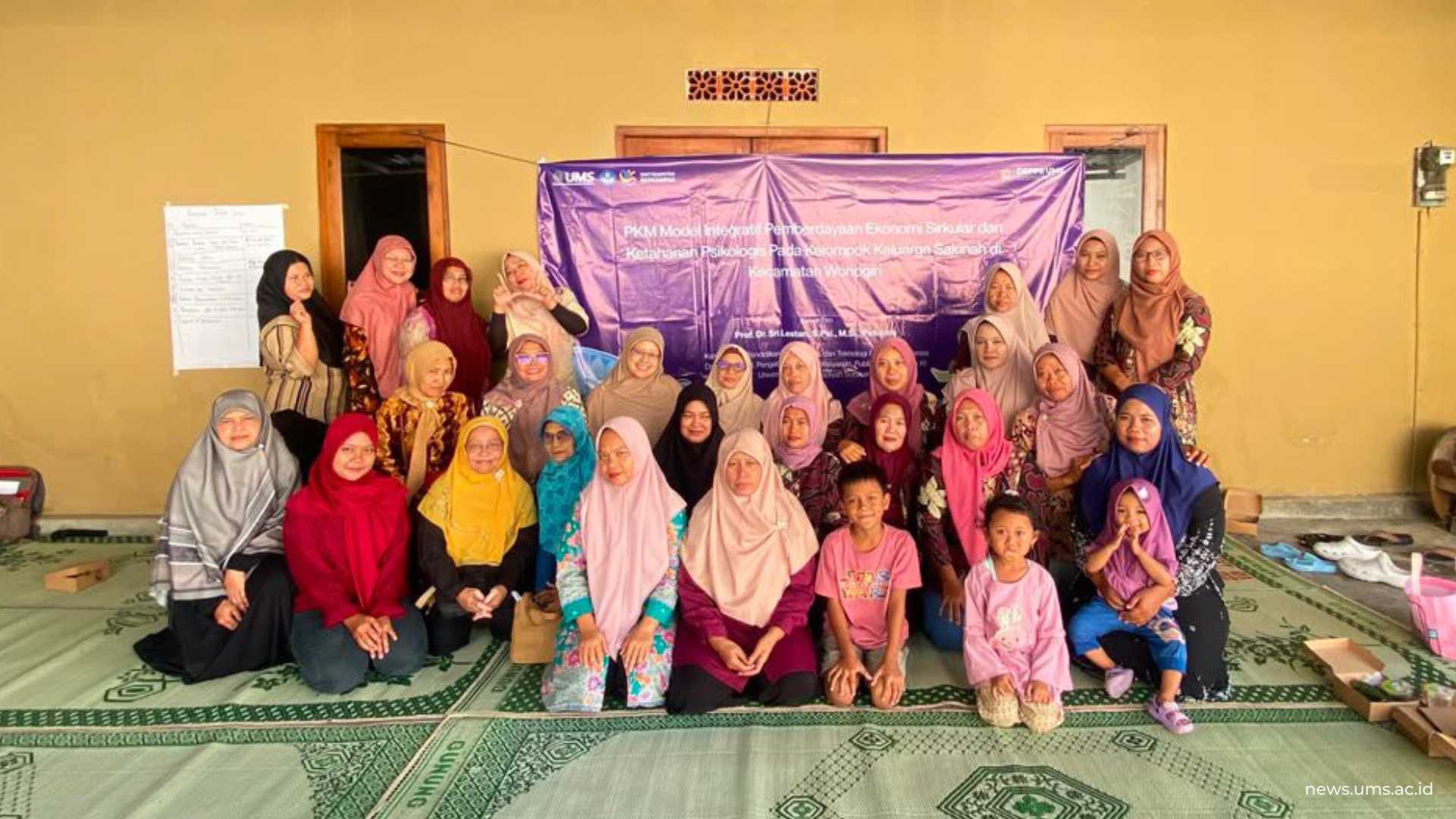
[Repost] ums.ac.id, SURAKARTA – The Community Service (PkM) Team of Universitas Muhammadiyah Surakarta (UMS) hosted a socialization event for a community empowerment program titled “An Integrative Model of Circular Economy Empowerment and Psychological Resilience for the Sakinah Family Group in Wonogiri Sub-district” on Wednesday (June 10, 2026). Funded by the Directorate General of Higher Education (Dikti), the initiative targets the Sakinah Family Group (KKS) across the villages of Manjung and Kerdukepik in Wonogiri Sub-district.
This program is spearheaded by Prof. Dr. Sri Lestari, S.Psi., M.Si., Psychologist, from the UMS Faculty of Psychology, alongside Dr. Siti Fatimah, S.Si., M.Sc., from the UMS Chemical Engineering Study Program, and Nining Sholikhah, S.E., M.Si., from the Corporate Management Study Program at Politeknik Pratama Mulia Surakarta. This cross-disciplinary collaboration also actively involves university students to provide comprehensive solutions for the community.
Sri Lestari explained that the program is strategically designed to address the multifaceted challenges faced by KKS members. The majority of this community consists of housewives who shoulder the dual responsibility of being heads of their households as well as ultra-micro entrepreneurs, primarily operating in the culinary sector.
“The issues they face are not solely related to the economy, but also encompass environmental concerns and mental health. Therefore, the approach utilized in this program is highly integrative,” she stated when interviewed on Friday (June 12, 2026).
One of the primary hurdles faced by KKS members is the management of used cooking oil. High cooking activity leads to a continuous accumulation of waste oil, while the repeated use of cooking oil poses serious potential health risks to both their families and consumers.
Furthermore, these micro-entrepreneurs face significant challenges in financial management. The absence of structured financial records often results in the intertwining of business capital and daily household expenses. This condition is exacerbated by their double burden as both homemakers and business owners, which can significantly impact their psychological well-being.
To tackle these diverse challenges head-on, the community service team introduced three main core programs: training on processing used cooking oil into economically valuable multipurpose laundry soap, training in marketing and basic financial management, and gratitude training aimed at enhancing psychological well-being and daily happiness.
The socialization event, held at the KKS Secretariat in Kerdukepik, was highly interactive. Rahadi, a representative from the PSA BOCAHPINTAR Foundation, was also present acting as a community facilitator and liaison between the service team and local partners. The foundation expressed its full readiness to support the long-term sustainability of the program initiated by the UMS team.
The participants’ enthusiasm was palpable throughout the event. KKS members actively took notes on the materials presented, particularly regarding the hidden dangers of repeatedly using cooking oil and techniques for the initial purification of used oil. Impressively, when the host deliberately shared incorrect information as a test, the participants immediately corrected it based on the knowledge they had just acquired.
Ambarwati, a participant representative from Manjung Village, expressed her deep appreciation for the initiative. “On behalf of the participants from Manjung, I would like to express my gratitude for the opportunity to learn something new. We hope to apply the knowledge that has been shared today to realize our business aspirations through this program,” she remarked.
A similar sentiment was shared by Yatini, the representative of KKS Kerdukepik. “On behalf of the mothers in Kerdukepik, I want to say thank you for the chance to learn so much from the community service team. We hope the knowledge provided will be highly beneficial for us moving forward,” she expressed.
This socialization marks the initial phase of a broader empowerment program scheduled to run over the next two to three months. The UMS PkM team is fully committed to continuously assisting KKS members through advanced training, regular monitoring, and periodic evaluations to ensure the program becomes independent and sustainable in the long run. (Fika/PR)