Surakarta, 25th April 2026 – In an effort to produce competent and adaptive professional psychologists, developing highly targeted learning guidelines is an absolute necessity. Responding to this need, a “Training on the Development of Psychological Assessment and Intervention Modules” was held, aiming to update the curriculum to be more applicable and grounded in real-world cases.
The event, guided by Rahma Ayuningtyas, M.Psi., Psychologist, acting as the Master of Ceremony (MC), was opened with a strategic presentation by the Head of the Professional Study Program, Susatyo Yuwono, M.Si., Psychologist. In his opening remarks, Susatyo highlighted a classic challenge in psychology education that must be immediately addressed.
“For a long time, we have frequently encountered issues where professional learning modules still tend to be heavily theoretical with minimal operational guidance. As a result, students often experience a theory-practice gap, a condition where they struggle to connect the theories learned in class with actual practice in the field,” Susatyo asserted.
Stemming from this issue, the training established three main objectives: understanding the concept of competency-based modules, integrating theory with practice, and developing a truly operational module framework.
The Importance of Evidence-Based Practice (EBP) in the Consulting Room
Entering the main material session, Wisnu Sri Hertinjung, acting as the Resource Person for this Workshop, explained that the backbone of developing these new modules is the Evidence-Based Practice (EBP) and Competency-Based Training (CBT) approaches.
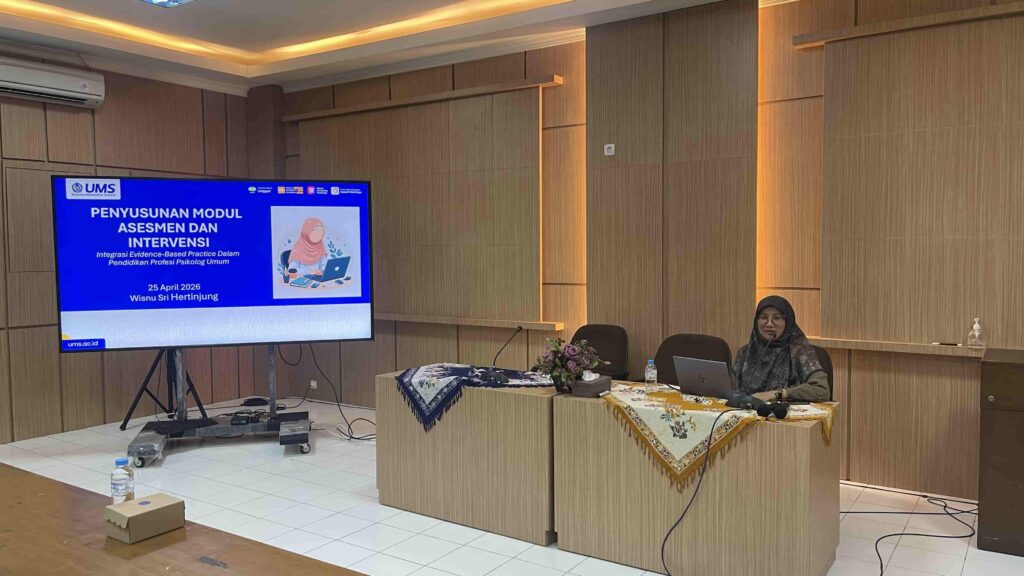
EBP is a professional practice approach that relies on more than just instinct; it is the optimal integration of three elements: research evidence, the practitioner’s clinical expertise, and client characteristics.
“For example, in assessment, intelligence tests like WISC or CPM indeed possess high scientific validity. However, in practice (EBP), a psychologist cannot apply a one-size-fits-all approach. We must consider the client’s age, language abilities, and cultural background. If a child has language barriers, the CPM test might be a more appropriate alternative,” Hertin explained, providing a technical illustration.
A similar principle applies to intervention modules. Although extensive literature states that Cognitive Behavioral Therapy (CBT) is effective for mild to moderate depression, its field practice must still be tailored to local cultural values and the client’s age.
Assessment in EBP is not viewed as a rigid procedure, but rather a continuously evolving (iterative) hypothesis-testing process utilizing multiple methods (multimethod), such as interviews, observations, and psychological tests.
Building Operational and Measurable Modules
Besides EBP, the training also emphasized the importance of Competency-Based Training (CBT) in module writing. This approach focuses on outcomes, where assessment criteria must be made as clear as possible to ensure the evaluation of student performance is objective.
To move away from solely focusing on theory, the new modules are required to have tangible implications: they must be operational (featuring concrete steps), case-based (using real-world situations), integrated, and measurable.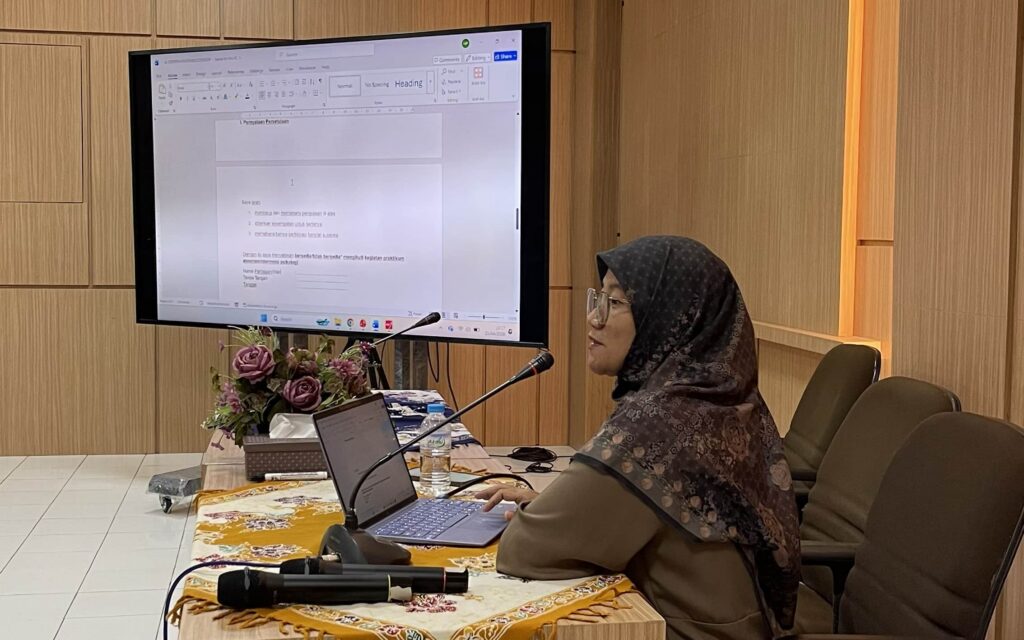
“A professional module must not be written relying on only a single literature source. The module must be a concoction of scientific journals, psychological test manuals, professional practice guidelines, lecturers’ research findings, to best practices or direct clinical experiences from the lecturers themselves when handling clients,” the speaker stressed.
A Concrete and Specific Structure
During this training, participants were also equipped with guidelines to distinguish their drafting focus. The Assessment Module will be focused on data collection, interpretation, and the formulation of diagnostic hypotheses. Meanwhile, the Intervention Module will center around planning behavioral change programs.
To accelerate implementation, the training concluded with a highly structured scheme for forming the module drafting teams. The teams were divided based on specializations, ranging from assessment, intervention, and case determination teams, to teams responsible for formulating evaluations and rubrics.
Eventually, every resulting intelligence test assessment module will not only contain the theoretical foundations and scoring methods, but will also be equipped with practical appendices that are mandatory in the professional world. These appendices include raw score records, client behavioral observation note sheets, standardized templates for writing psychological reports, informed consent forms, to grading rubric sheets from the supervisor.
Through the standardization of these modules, it is hoped that psychology students will be able to practice much more concretely and accurately represent the true professional world.